Lead scoring and enrichment
Your sales team cannot tell which leads to call first
A long list is not a pipeline. I build a flow that gathers what is publicly known about a lead, scores it against criteria you set, and shows the reason, so a salesperson can agree or disagree.
WHEN TEAMS CALL
When lead scoring helps
- Leads are called in the order they arrived.
- Research takes longer than the call.
- Good leads are found after they bought elsewhere.
- Scores exist and nobody trusts them.
When it is not the right fit. If you can comfortably call every lead, you do not need a score.
HOW I WORK
Lead scoring, step by step
Each step ends with something you can look at, so nothing is built on a guess.
Define a good lead
We write down what your best customers have in common, in terms that can be checked.
Gather what is available
Details come from your CRM and permitted public sources, and each one keeps its source.
Score in the open
Every criterion has a weight you can see and change. Simple rules come first, models only where they help.
Remove duplicates
Leads are matched against existing records before they reach sales.
Learn from outcomes
Scores are compared with what really happened, and the weights are adjusted.
WHAT YOU GET
Deliverables
- An enrichment and scoring workflow
- A ranked list in your CRM or a sheet
- Visible weights and reasons
- A report comparing scores with outcomes
WHAT I NEED
To get started
Your criteria for a good lead, a sample of past leads with outcomes, and CRM access.
Further reading: the scikit-learn notes on model evaluation.
QUESTIONS
Before you ask
Is this machine learning?
Only if you have enough history. With less data, clear weighted rules work better and are easier to trust.
Where does the data come from?
Your own systems and sources that permit this use. Each field records where it came from.
Can sales overrule a score?
Yes, and the overrule is recorded, because it is the best evidence for improving the rules.
RELATED WORK
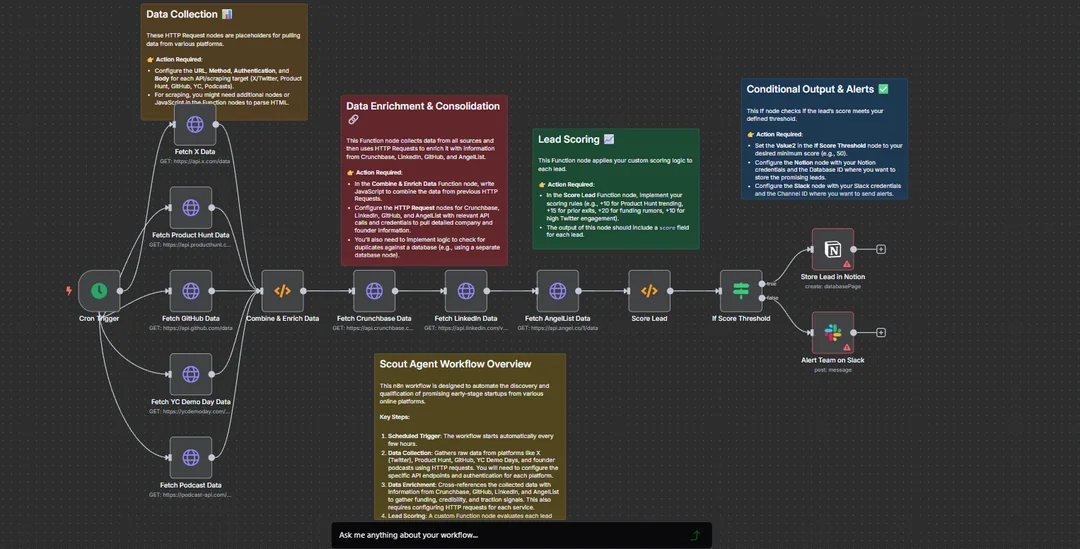
A scheduled agent gathers startup data from six sources, scores each lead against weighted criteria, and records the ones that pass.
Lead discovery and scoring agent Read the work
WORKING TOGETHER
What to expect
- Who does the work
- I do, from the first conversation to the handover. Nothing is passed to someone else.
- Where it happens
- Remotely, with calls planned around overlapping hours. Your data stays in your environment wherever possible.
- Confidentiality
- I am happy to sign an NDA before seeing anything, and I do not name clients.
- Before work starts
- You receive a written scope and a quotation. Nothing begins until you agree to both.
- At the end
- Everything is documented and handed over, with logic in version control. You own it.
- Reply time
- I answer new requests within one to two days.
RELATED SERVICES
Often needed together.
Tell me what you need. I will send you a quotation.
A few lines about the problem and the data behind it are enough to start. I reply with questions, then a clear scope and a quotation.